RECOGNITION AND ENFORCEMENT OF ARBITRATION AWARDS DISCUSSED AT UWED
RECOGNITION AND ENFORCEMENT OF ARBITRATION AWARDS DISCUSSED AT UWED
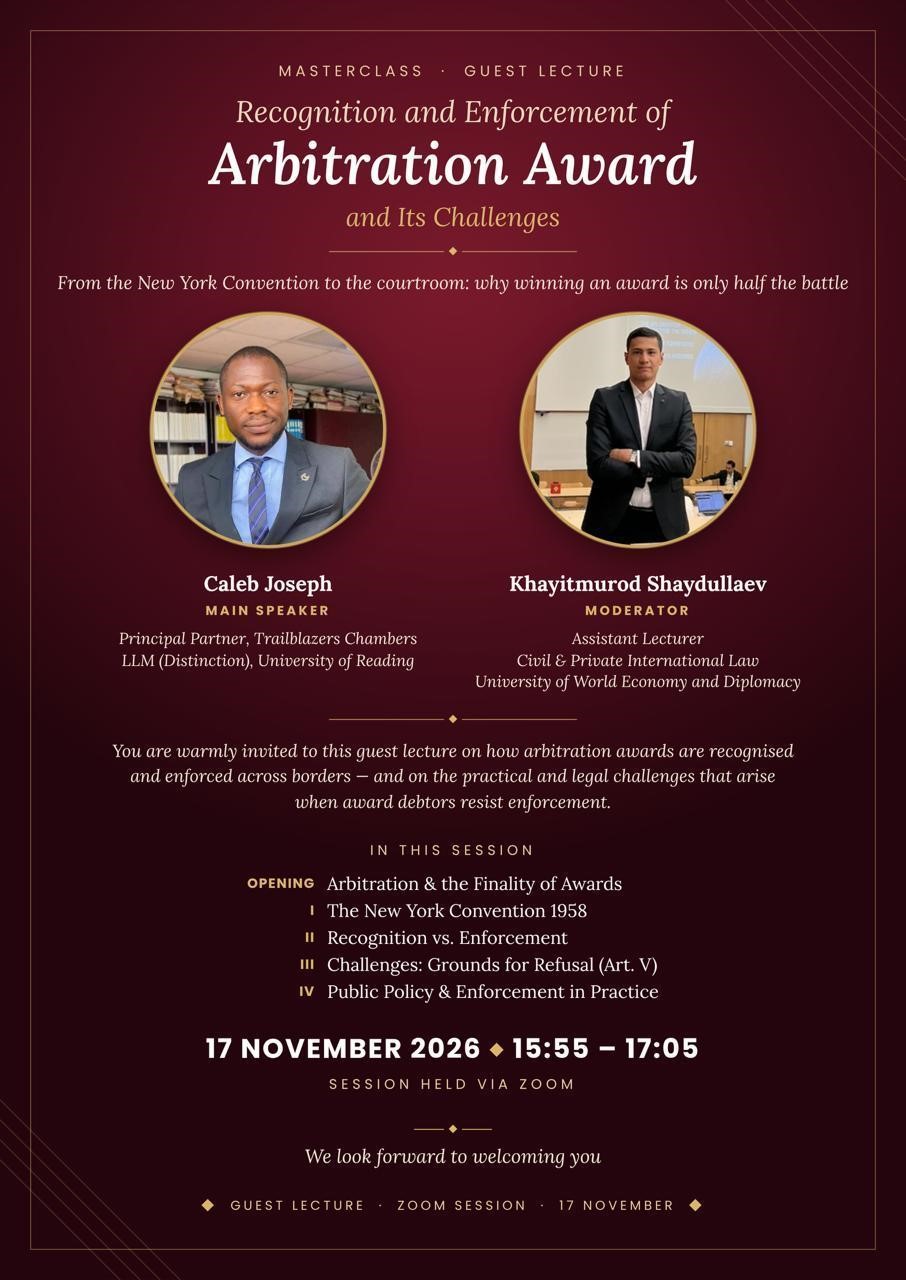
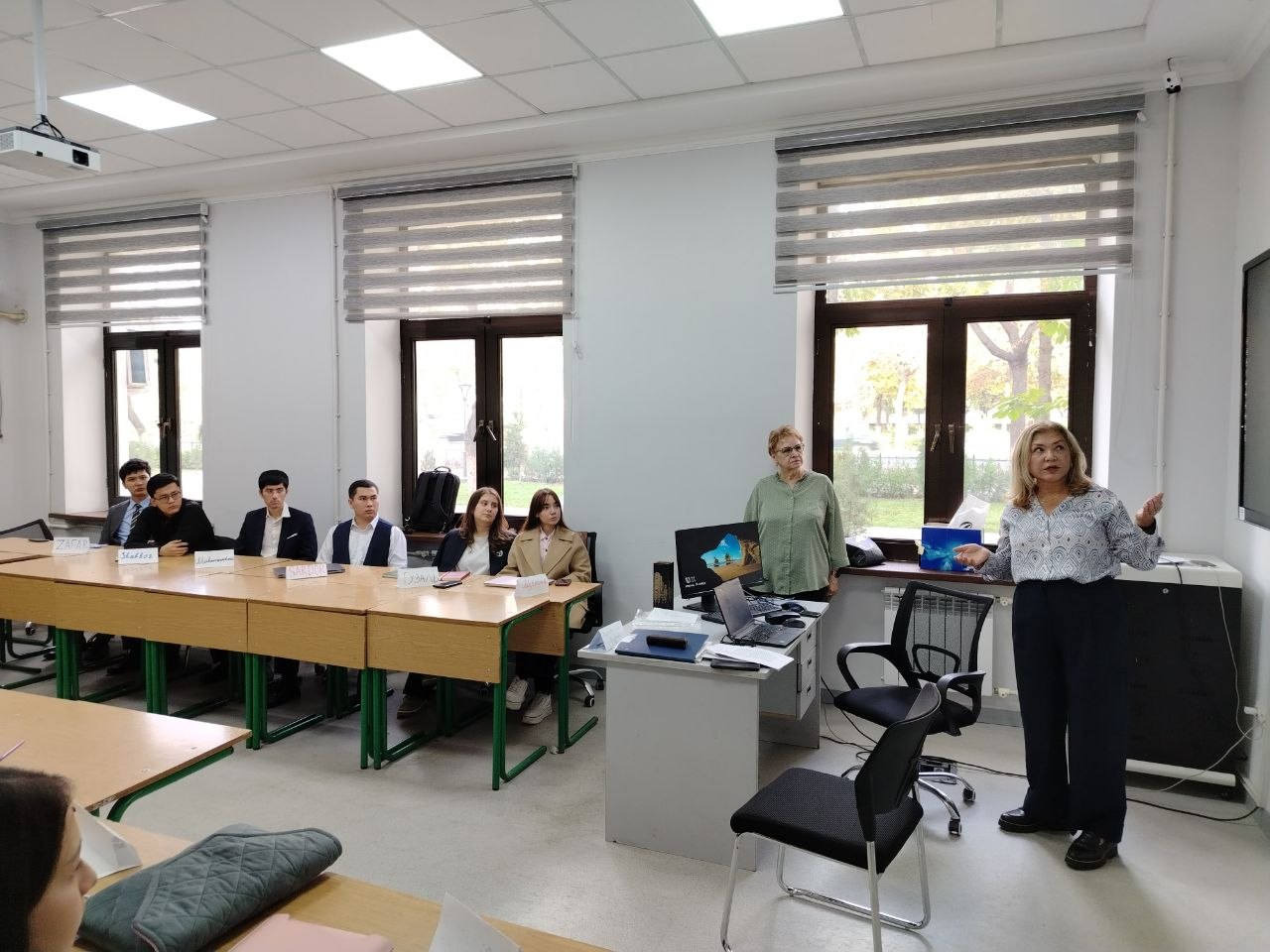
On November 17 of this year, a master class dedicated to one of the most pressing topics in international arbitration – “Recognition and Enforcement of Arbitration Award and Its Challenges” – was held in a hybrid format at the University of World Economy and Diplomacy: participants gathered in a university classroom, while the speaker joined online via Zoom. The event was organized by Kh. Shaydullaev, Assistant Lecturer of the Department of Civil Law and International Private Law Disciplines, with the aim of introducing students to what happens after an award is rendered – its recognition and enforcement in foreign states – and to the practical and legal obstacles that arise along the way, drawing on international experience.
The main speaker of the master class was Caleb Joseph, Principal Partner at Trailblazers Chambers and holder of an LLM in International Commercial Law (Distinction) from the University of Reading (United Kingdom). The session was moderated by Khayitmurod Shaydullaev, Assistant Lecturer of the Department. Along with the professors and teachers of the Department of Civil Law and International Private Law Disciplines, UWED master’s students actively took part in the session, putting questions to the speaker and exchanging views.
During the session, the principle of finality of arbitral awards, the criteria distinguishing an award from other procedural decisions of the tribunal, and the formal requirements for an award – writing, signatures, reasons, date and seat – were comprehensively analyzed. The speaker explained that a dissatisfied party has two routes: setting the award aside before the courts of the seat (Article 34 of the UNCITRAL Model Law; Article 50 of the Law of the Republic of Uzbekistan “On International Commercial Arbitration”) and resisting enforcement in the state where enforcement is sought. Using sections 67, 68 and 69 of the English Arbitration Act 1996, the 2025 amendments, and well-known cases such as Dallah v Pakistan, Lesotho Highlands and Nigeria v P&ID, he showed how rarely such applications succeed in practice.
Furthermore, the 1958 New York Convention on the Recognition and Enforcement of Foreign Arbitral Awards was at the center of the discussion. It was noted that more than 170 states are now party to the Convention, and that Uzbekistan joined it in 1996. The difference between recognition and enforcement, the closed list of grounds for refusal under Article V, and in particular the concept of public policy were examined through practical examples. Participants also discussed the differing approaches to enforcing an award that has been annulled at the seat, as well as Uzbekistan’s recent reforms – the establishment of the Tashkent International Arbitration Centre (TIAC), the 2021 law, the guidance of the Plenum of the Supreme Court, and the creation of the Tashkent International Commercial Court. This scientific-practical dialogue is distinguished by its harmony with the ideas of Sustainable Development Goal 16 – “Peace, Justice and Strong Institutions” and Goal 17 – “Partnerships for the Goals”. It was specifically emphasized that a reliable mechanism for enforcing arbitral awards is an important guarantee of our country’s investment attractiveness and of stable international trade relations.
At the end of the event, participants worked in groups on a practical case based on a hypothetical dispute between an Uzbek and a German company and presented their conclusions. Conclusions were also drawn on how closely the principles of SDG target 16.3 – “Ensuring the rule of law and expanding access to justice” – are linked with the finality of arbitral awards and the guarantees of their cross-border enforcement. Undoubtedly, such master classes serve to develop international legal thinking among future specialists and to ensure the strong integration of theory and practice.
| Date: | 18.11.2026 |
| Views: | 12 |
| Share: |