A Master Class on International Trade Relations and Legal Mechanisms for Dispute Resolution Was Held at UWED
A Master Class on International Trade Relations and Legal Mechanisms for Dispute Resolution Was Held at UWED
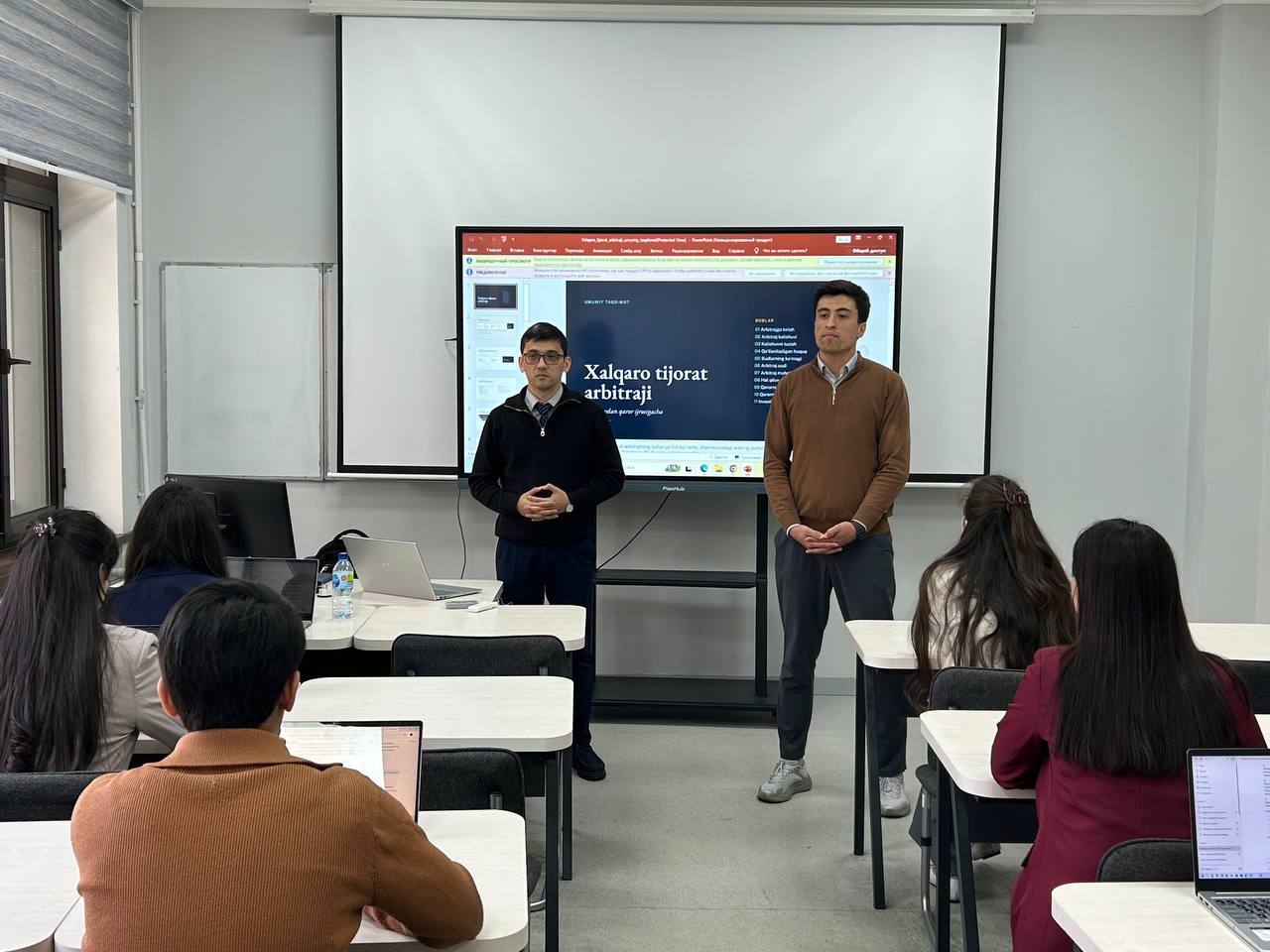
On October 29, 2026, the University of World Economy and Diplomacy (UWED) hosted a master class entitled “International Trade Relations and Legal Mechanisms for Dispute Resolution in International Economic Law,” initiated by H. Eshboyev, a lecturer at the Department of International Law and Public Law Disciplines. A. Abdurasulov, a lecturer at Tashkent State University of Law, participated as a guest expert and briefed students on the fundamental principles of the legal regulation of international trade relations, dispute settlement mechanisms within the World Trade Organization, and the role and significance of international commercial arbitration in international economic relations.
The master class addressed the legal foundations of international trade relations, the institutional and procedural mechanisms for dispute settlement within the World Trade Organization system, the specific features of international commercial arbitration, and the legal rules applicable to international trade disputes. Particular attention was paid to arbitral procedures, alternative and effective dispute resolution methods, and their importance in ensuring the stability of international economic cooperation. The effective resolution of international trade disputes, the development of stable economic relations, and the strengthening of international economic cooperation are closely linked to Sustainable Development Goal 16 — “Peace, Justice and Strong Institutions” (SDG 16).
A key feature of the master class was its focus on bridging theoretical knowledge with the practical application of international law and developing students’ skills in the legal analysis of international trade disputes, examining international agreements and dispute resolution mechanisms, understanding arbitral procedures, and independently addressing international economic and legal issues. The direct involvement of the guest expert enabled students to gain first-hand insight into current legal issues relating to the resolution of international trade disputes, international arbitration practice, and the practical aspects of dispute proceedings. This contributes to the development of high-quality, modern and practice-oriented education and supports the achievement of Sustainable Development Goal 4 — “Quality Education” (SDG 4).
Ensuring the rule of law in international trade relations, developing mechanisms for the fair and effective resolution of disputes, and strengthening legal cooperation between states and international institutions are essential conditions for establishing sustainable economic relations at the international level. In this regard, such academic and practical events dedicated to international trade law and dispute resolution mechanisms contribute to deepening students’ knowledge, developing their professional competencies, and preparing qualified specialists in the field of international law.
| Date: | 30.10.2026 |
| Views: | 8 |
| Share: |