Law in Transition: UWED Scholars Address Digital Disruption, Governance, and Legal Certainty
Law in Transition: UWED Scholars Address Digital Disruption, Governance, and Legal Certainty
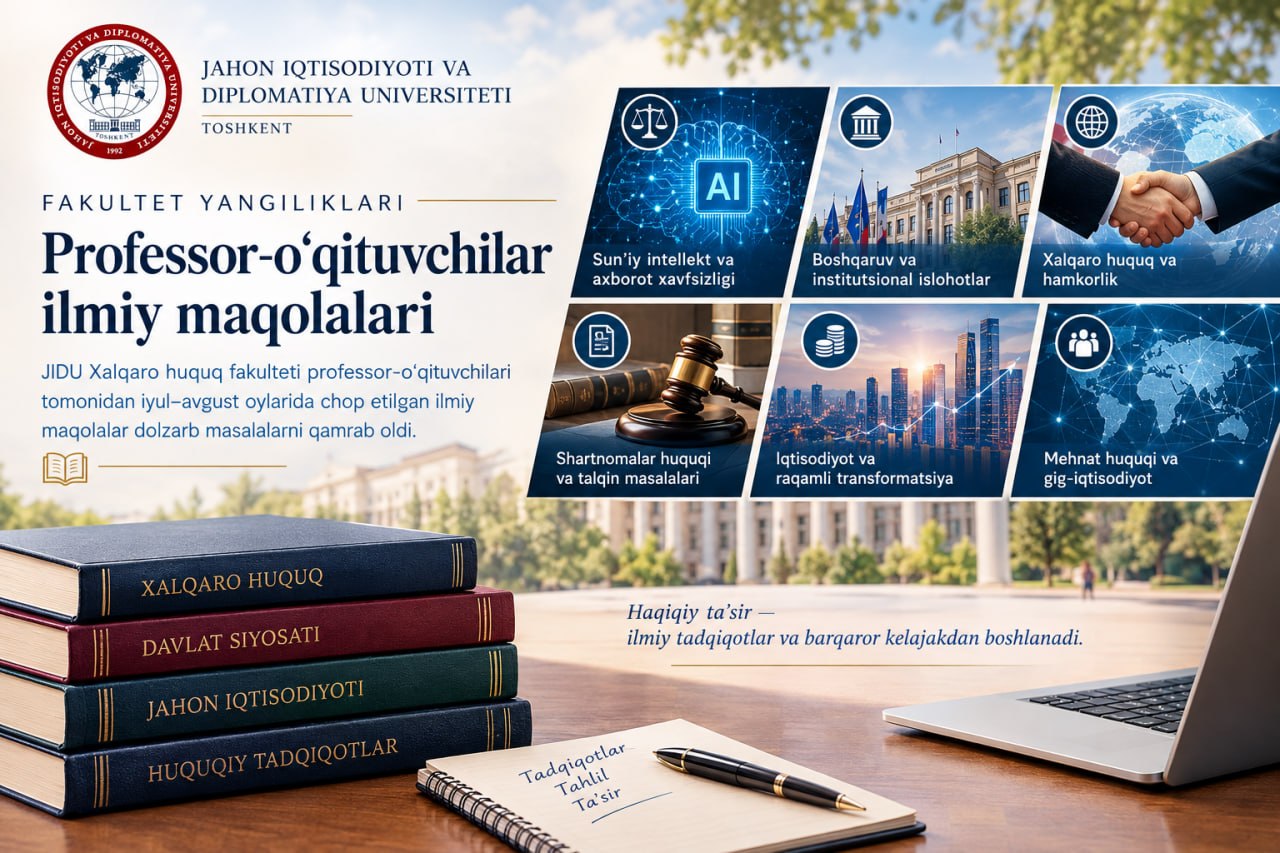
In a series of recent publications, Professors and Lecturers from the International Law faculty at the University of World Economy and Diplomacy confront pressing issues head-on: the rise of algorithmic management, the persistence of institutional corruption, and the enduring complexities of contractual interpretation. While their topics range from artificial intelligence to the gig economy, a single, powerful thesis unites their work: modern law must abandon rigid formalisms and embrace flexible, fact-based approaches to remain effective.
Professors Nugman Nugmanov and Venera Sayfullaeva discussed in their article,
"Modern Approaches to the Legal Regulation of Artificial Intelligence in the Field of Information Security" that no unified international AI approach exists - the EU, US, and China offer conflicting models. Instead, Uzbekistan must develop its own scientifically grounded national framework, reforming domestic legislation on informatization, personal data, and copyright rather than adopting a foreign template.
Professor Asema Beishembek Kyzy and Co-authors (including Zarina Israilova) article titled, "Analysis of the Functioning of Corrupt Networks in State Governance: Contemporary Political and Legal Methods of Combating Corruption" examines how corruption persists as a systemic network, with Kyrgyzstan ranking 141st on the CPI. Despite strong laws, enforcement fails due to political pressure. Digitalisation (e.g., the "Tunduk" e-portal) cuts petty corruption by 35%, urging stronger independent bodies and technological transparency to dismantle entrenched networks.
Lecturer Qobiljon Nosirov, defended his thesis in his article "The Parol Evidence Rule in Modern UK Contract Law: Dead Doctrine or Living Principle?" by arguing how despite critics declaring it obsolete, the rule remains vital - evolved from an absolute bar into a strong rebuttable presumption. It prevents informal negotiations from overriding clear written terms, while modern "Entire Agreement Clauses" codify this principle, ensuring commercial certainty alongside contextual interpretation.
Lastly, Professor Bahodir Hamroqulov’s article on "Determining the Labour-Law Status of Workers Under Algorithmic Management on Digital Labour Platforms" stated that legal status must depend on actual control, not contract labels. Algorithms increasingly manage tasks, ratings, and deactivations—acting like employers. Drawing on ILO Convention No. 193, he proposes a two-stage model for Uzbekistan: basic protections for all, plus fact-based reclassification to employment when algorithmic control is proven.
All four of these articles reveal a profound consensus among UWED's legal scholars: the age of rigid formalistic legal thinking is over. The common thread is context-sensitivity.
Whether regulating AI, fighting corruption, interpreting contracts, or protecting gig workers, UWED inInternational Law Faculty scholars advocate for legal frameworks grounded in facts, adaptable to technological change, and responsive to institutional realities.
| Date: | 15.09.2026 |
| Views: | 115 |
| Category: | International Law |
| Share: |