Cyber Literacy as Protection Against Fraud: Police Officers Deliver Master Class for UWED Students
Cyber Literacy as Protection Against Fraud: Police Officers Deliver Master Class for UWED Students
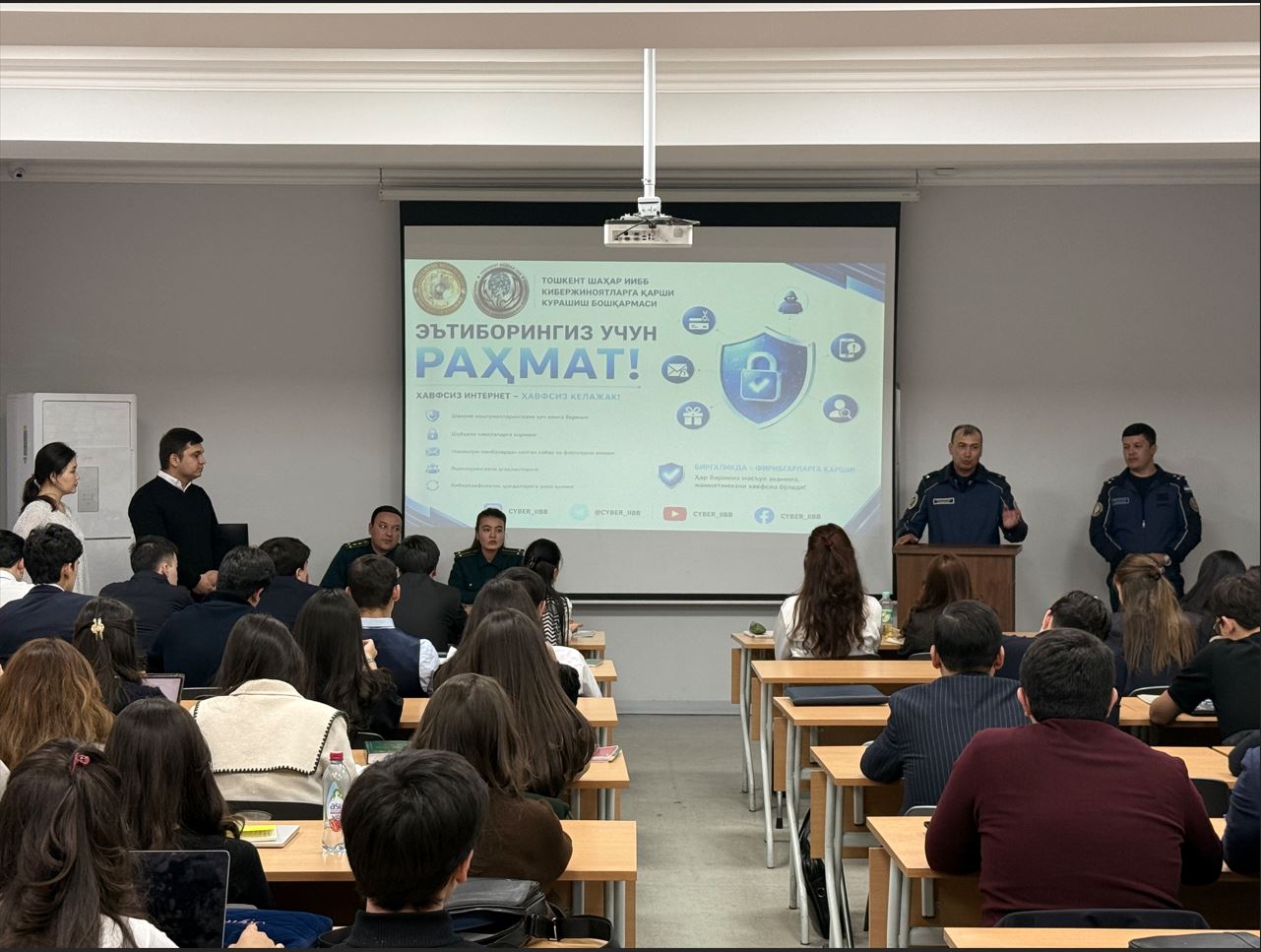
On November 16, 2026, the University of World Economy and Diplomacy (UWED) hosted a master class titled “Modern Cyber Fraud Schemes and Measures to Protect Against Them” for second-year students of the Faculty of International Law.
The event was organized as part of the Criminal Law course under the supervision of Dilshod Bakhtiyor ugli Soliyev and Naubakhar Bakhadir qizi Uzakbayeva, lecturers at the Department of International Law and Public Law Disciplines.
The session featured representatives of the Department for the Prevention of Information Technology-Related Crimes under the Internal Affairs Coordination Directorate of Mirzo Ulugbek District. The invited experts included Head of Department M. Mirzokhidov, Inspector and Lieutenant S. Zulpikorova, Youth Affairs Prevention Inspector Sh. Boymatov, and J. Khojiyev.
During the master class, the experts introduced students to the most common methods of cyber fraud. The discussion covered fraudulent calls impersonating banks and law enforcement agencies, malicious applications distributed through APK files, fake investment and trading platforms, and scams involving online shopping and employment opportunities.
Particular attention was given to emerging digital threats, including deepfake technologies, AI-generated voice impersonation, unauthorized access to Telegram accounts, recruitment into illegal gambling activities, and violations related to the circulation of crypto-assets.
Drawing on practical examples, the law enforcement representatives explained how cybercriminals operate and provided recommendations on protecting personal information and financial assets. Students also learned about the criminal-law classification of cyber fraud and were advised to contact the police emergency number 102 if they encounter or suspect fraudulent activities.
The master class was conducted in an interactive format, allowing students to engage directly with the invited experts, raise questions about emerging cybersecurity threats, and discuss legal and practical measures to prevent cybercrime.
The event provided a valuable opportunity to bridge theoretical knowledge of criminal law with the practical experience of law enforcement agencies. It also contributed to strengthening students’ digital literacy, legal awareness, and ability to navigate the digital environment safely.
The master class was also aligned with the United Nations Sustainable Development Goals (SDGs). In particular, it supported the objectives of SDG 16, “Peace, Justice and Strong Institutions,” through its relevance to Targets 16.a and 16.4, which address institutional capacity for crime prevention and the reduction of illicit financial flows. Furthermore, the event contributed to SDG 4, “Quality Education,” particularly Target 4.4, by promoting the development of relevant technical and digital skills among young people.
| Date: | 16.11.2026 |
| Views: | 2 |
| Share: |