UWED HOSTS ROUNDTABLE WITH INTERNATIONAL EXPERTS ON “MASTER’S DEGREE ABROAD: KEY STRATEGIES TO YOUR SUCCESSFUL ADMISSION”
UWED HOSTS ROUNDTABLE WITH INTERNATIONAL EXPERTS ON “MASTER’S DEGREE ABROAD: KEY STRATEGIES TO YOUR SUCCESSFUL ADMISSION”
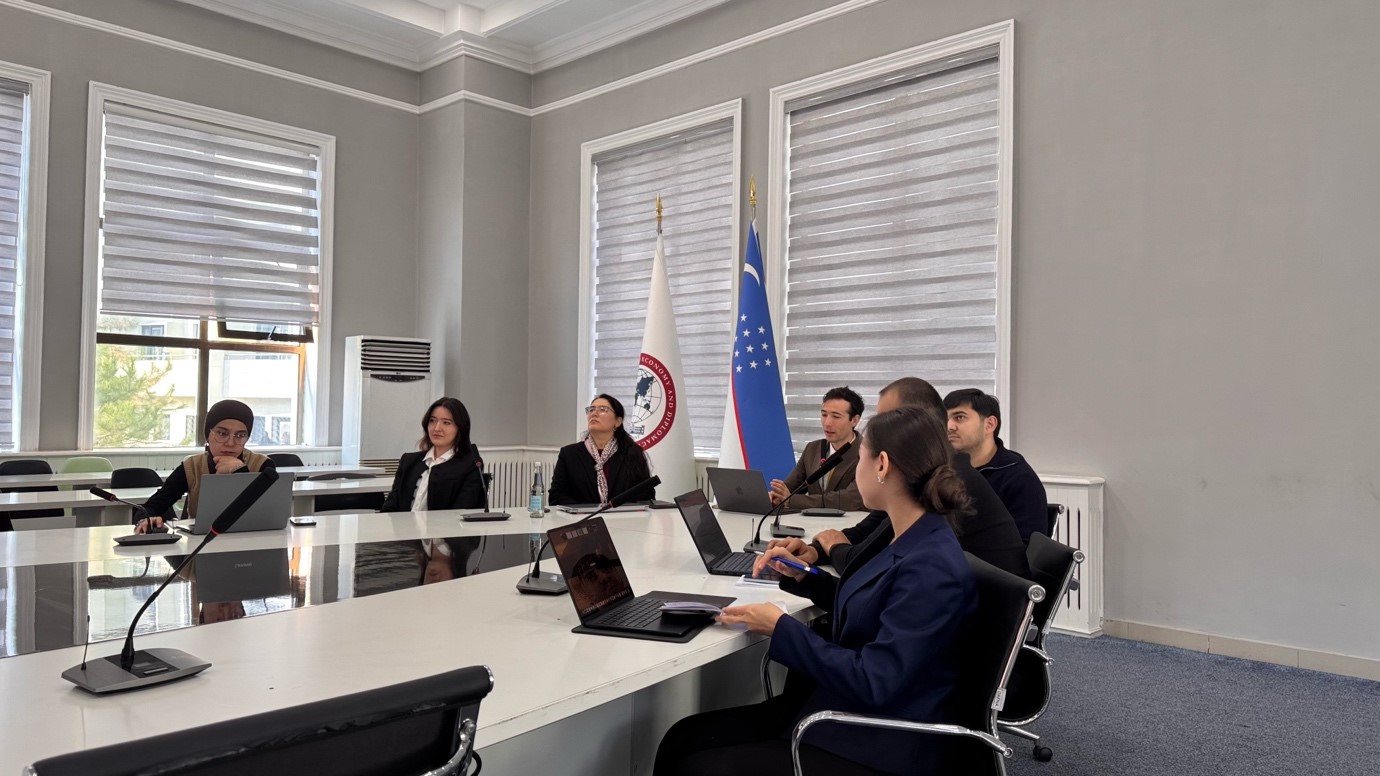
On 3 November of this year, the University of World Economy and Diplomacy (UWED) hosted a roundtable discussion with international experts on “Master’s Degree Abroad: Key Strategies to Your Successful Admission,” held in a hybrid format — in the SOK Conference Hall and via Zoom — starting at 11:30. The event was organized and moderated by Alisher Bobonazarov, lecturer at the Department of Civil Law and International Private Law Disciplines of UWED, who holds an LLM degree from the University of Szeged under the Stipendium Hungaricum scholarship programme. The purpose of the roundtable was to share practical guidance and first-hand experience with students on successfully applying for master's degree programmes abroad.
Alongside the moderator, the roundtable brought together three guest speakers who had themselves completed or were pursuing graduate studies abroad: Zubayda Murotaliyeva, holder of an MSc degree from the University of Aberdeen and a scholar of the Eötvös Young Fellowship (EYUF); Farangiz Razakova, Founder of Femida LLC and holder of an LLM degree from Pennsylvania State University, also an EYUF scholar; and Rachida Roukiaoui, PhD, an international relations expert and lecturer at the University of Szeged, a graduate of Sciences Po Lille and a Stipendium Hungaricum scholarship holder.
During the discussion, the speakers shared practical strategies for successful admission to master's degree programmes abroad, including the selection of a suitable university and programme, the preparation of a strong motivation letter and academic statement, obtaining letters of recommendation, meeting language and standardized test requirements, and effectively presenting one's academic and professional experience. Particular attention was paid to international scholarship opportunities, including the Stipendium Hungaricum and Eötvös Young Fellowship programmes, the stages of the scholarship application process, and ways of adapting successfully to study and life in a new academic environment.
The event was attended by the teaching staff of the Department of Civil Law and International Private Law Disciplines, including the Head of the Department, Sherzodbek Masadikov, and Professor Dilfuza Imamova, lecturer Qobiljon Nosirov, as well as teaching assistants Munira Ismoilova, Xayitmurod Shaydullayev, Muhammadjon Masharipov and Mastura Yusupova, who took an active part in the discussion alongside the students.
This roundtable resonates with the ideas of Sustainable Development Goal 4 — “Quality Education,” in particular target 4.3, which calls for ensuring equal access for all to affordable and quality tertiary education, and target 4.b, which calls for expanding the number of scholarships available for enrolment in higher education in developed countries. The event also reflects Goal 17 — “Partnerships for the Goals,” specifically target 17.6, concerning the strengthening of international cooperation and the exchange of knowledge and experience among institutions.
Such meetings carry considerable educational and moral value, inspiring students to set ambitious academic goals, broadening their outlook, and encouraging a generation of young specialists who, having gained knowledge and experience abroad, return to apply it for the development of their homeland. Events of this kind strengthen the intellectual potential of the nation and the sense of responsibility among youth for their own professional future.
| Date: | 03.11.2026 |
| Views: | 31 |
| Share: |