UWED researchers study Uzbek migration to South Korea and Japan with government partners
UWED researchers study Uzbek migration to South Korea and Japan with government partners
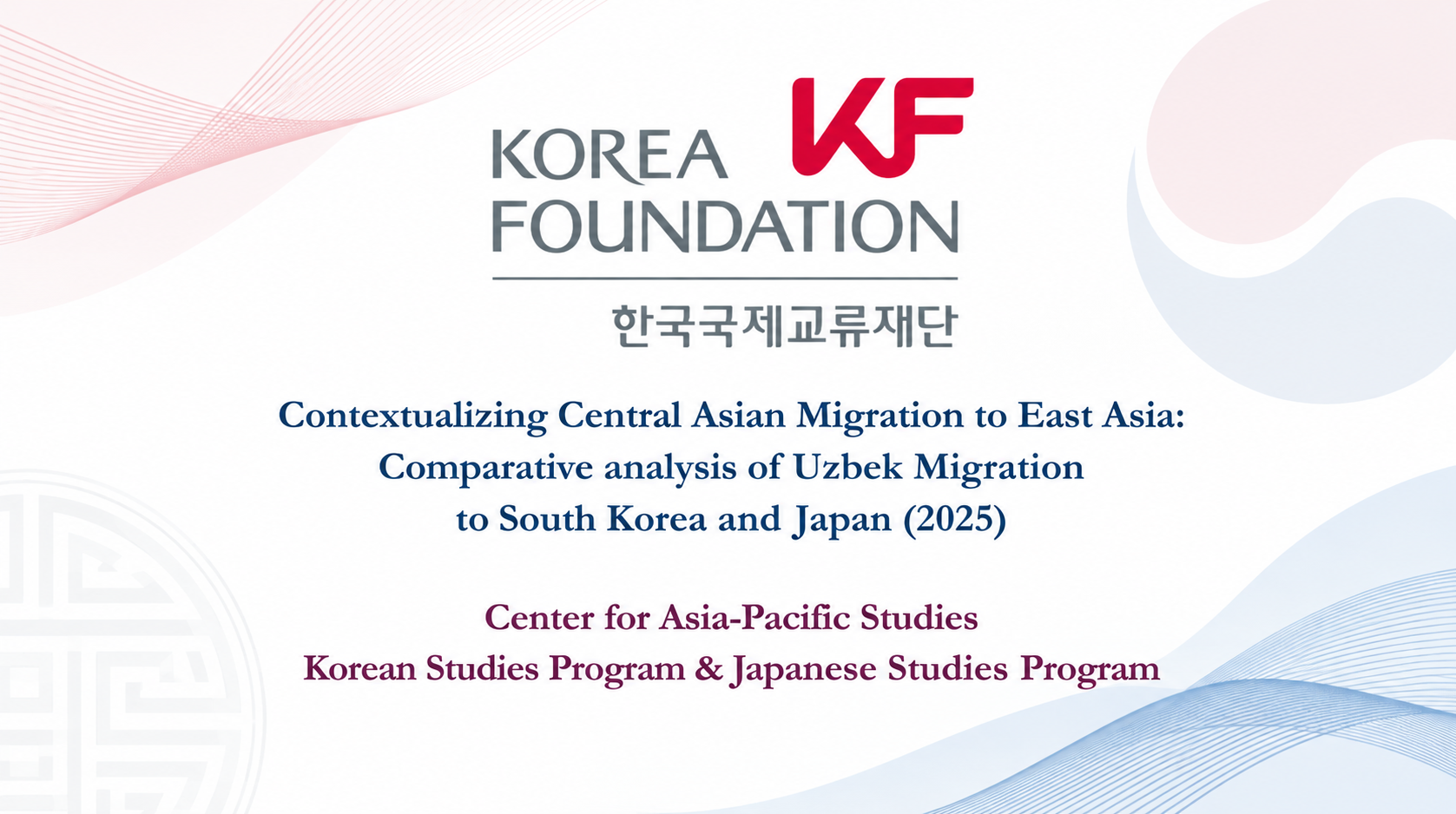
From 1 January to 31 December 2025, the Institute for Advanced International Studies (IAIS) at the University of World Economy and Diplomacy is carrying out a policy-oriented research project, “Contextualizing Central Asian Migration to East Asia: Comparative Analysis of Uzbek Migration to South Korea and Japan.” The project is implemented in partnership with the Korea Foundation.
East Asia, and South Korea and Japan in particular, is becoming an important destination for Uzbek citizens going abroad to work and study. Uzbekistan’s youth population is growing and economic pressures are rising. The country is looking for effective ways to manage labour and educational mobility, and it wants to strengthen bilateral cooperation with its East Asian partners. The project aims to support these goals with evidence.
The project is led by Professor Timur Dadabaev, Vice-Rector for Science and Innovations at UWED and Senior Associate Fellow at IAIS. The research team includes Dr. Azamat Seitov, Mekhriniso Abdurasulova, Jasur Soipov and Nigora Djalilova.
The research is carried out in cooperation with Uzbek government bodies responsible for labour migration and diaspora engagement, including the Ministry of Employment and Poverty Reduction and the Ministry of Foreign Affairs. The work has three main parts:
· Stakeholder mapping: interviews with these government agencies on how labour migration and diaspora relations are managed;
· Fieldwork with migrants: face-to-face and online interviews with Uzbek migrants in South Korea and Japan about their experiences, challenges and prospects;
· Comparative policy analysis: a comparison of South Korea’s and Japan’s migration frameworks and how they affect the integration of Uzbek migrants.
The project’s main aim is practical. Its findings will be turned into policy recommendations on how Uzbekistan can better manage labour migration, and how host countries can improve integration for Uzbek migrants. A detailed analytical report will be submitted to Uzbek government stakeholders and the Korea Foundation. The team also plans an international seminar on comparative migration dynamics between Korea and Japan along with articles in the international peer-reviewed journals Asian Survey, Pacific Review and the Journal of Eurasian Studies. The project reflected IAIS’s mission to bridge academic research and policymaking while it contributed to SDG 16 “Peace, Justice and Strong Institutions”.
| Date: | 25.12.2025 |
| Views: | 109 |
| Share: |