UWED Students Represent Latvia at the Model Conference of the States Parties to the UN Convention against Corruption
UWED Students Represent Latvia at the Model Conference of the States Parties to the UN Convention against Corruption
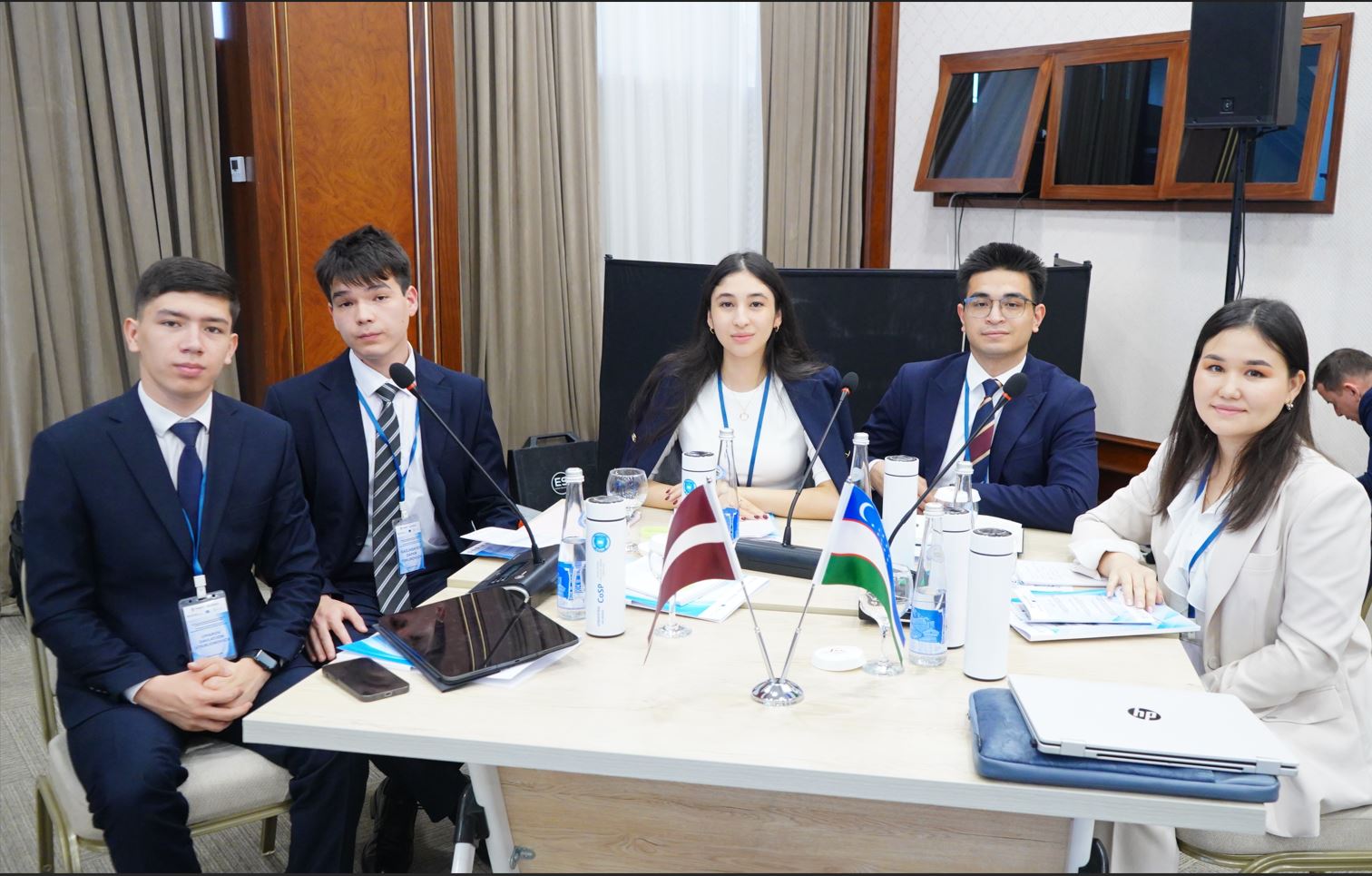
On 24 November 2026, the Law Enforcement Academy of the Republic of Uzbekistan hosted the Model Conference of the States Parties to the United Nations Convention against Corruption on "The Implementation Mechanism of the UN Convention against Corruption." Teams from leading universities and law enforcement academies of Kazakhstan, Kyrgyzstan, Tajikistan and Uzbekistan took part. The University of World Economy and Diplomacy was represented by Faculty of International Law students Damir Radjabayev, Davlatjon Umarov, Mironshokh Tursunboyev and Munisakhon Amerkulova. The team prepared under the supervision of Naubakhar Bakhadyrovna Uzakbaeva, lecturer at the Department of International Law and Public Law Disciplines.
The conference was opened by Yevgeniy Kolenko, First Deputy Head of the Law Enforcement Academy. Welcome remarks were delivered by Foziljon Otakhonov, Chairman of the Public Council under the Anti-Corruption Agency; Azat Irmanov, Senior Anti-Corruption Officer of the UNODC Regional Office; Yana Kurpisha, Programme Manager at the Delegation of the European Union to Uzbekistan; and Dr Viktor Kessler, Head of the GIZ Good Governance Programme. The session was moderated by Bogdan Yumatov of the Academy's Anti-Corruption Research and Education Centre.
The conference was held in two stages and focused on Article 5 of the Convention, "Preventive anti-corruption policies and practices." In the first stage, the UWED team represented the Republic of Latvia, as determined by a draw, with a presentation on "Latvia's Anti-Corruption Policy." Students described the work of the Corruption Prevention and Combating Bureau (KNAB), the central body coordinating anti-corruption policy, as well as the mechanisms for preventing conflicts of interest, internal control, public ethics and whistleblower protection. They also presented the methodology for assessing the effectiveness of internal control, developed by KNAB together with the OECD, and Latvia's cooperation with the UN, the OECD, the OSCE and GRECO.
In the second stage, the team spoke on behalf of Uzbekistan and compared the legislation of the two countries. Students noted that in some areas, such as whistleblower protection, the register of persons convicted of corruption offences and post-employment restrictions, Uzbekistan's legislation is even stricter than Latvia's. Drawing on Latvia's experience, the team put forward three proposals: to guarantee the independence of the Anti-Corruption Agency at the level of law, to adopt a law on declarations of assets and interests, and to introduce a mechanism to verify the lawful origin of officials' assets. The team also answered questions from experts and other delegations.
After each stage, the experts, Azat Irmanov and Florian Lair of UNODC and Pulat Urokov, Leading Inspector of the Anti-Corruption Agency, gave the teams comments and recommendations. The experts praised the UWED team's performance. The conference concluded with a discussion of its results and final conclusions, and all participants received certificates.
Taking part in the model conference allowed students to experience how international mechanisms work, carry out comparative legal analysis of a foreign state's legislation and practice, and develop the skills to defend a well-argued position on an international platform.
The event is directly linked to SDG 16 "Peace, Justice and Strong Institutions": it supports Target 16.5, substantially reducing corruption and bribery in all their forms, and Target 16.6, developing effective, accountable and transparent institutions at all levels. Bringing together UNODC, the European Union, GIZ and universities from Central Asia, the conference also supports SDG 17 "Partnerships for the Goals," while building students' practical competencies contributes to SDG 4 "Quality Education."
| Date: | 24.11.2026 |
| Views: | 42 |
| Share: |