UWED holds a round table for students on “Conflict of Interest in the Public Service: Mechanisms for Identification, Prevention and Resolution”
UWED holds a round table for students on “Conflict of Interest in the Public Service: Mechanisms for Identification, Prevention and Resolution”
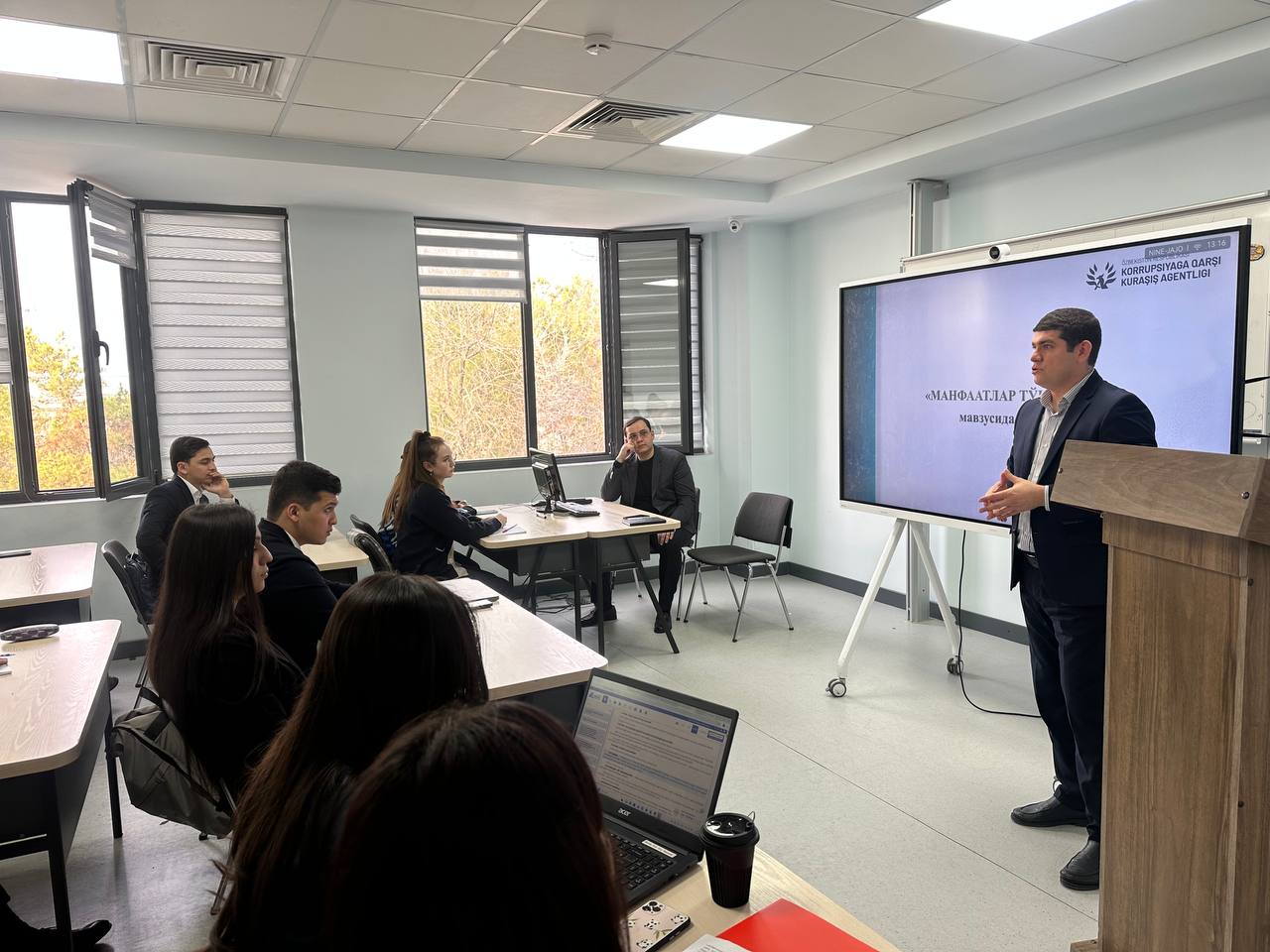
On November 21, 2026, a round table on "Conflict of Interest in the Public Service: Mechanisms for Identification, Prevention and Resolution" was organized within the course "Public Service". It was held at the initiative of Professor G. Ismailova and Senior Lecturer D. Soliyev of the Department of International Law and Public Law Disciplines of the University of World Economy and Diplomacy. Ulugbek Zokhidovich Saidov, a responsible officer of the Anti-Corruption Agency of the Republic of Uzbekistan, took part in the round table. He gave students a detailed overview of the Agency's structure and powers and of the work being carried out to prevent corruption in state bodies.
The round table discussed the concept of conflict of interest, its types and the situations in which it arises in the public service, on the basis of Law of the Republic of Uzbekistan No. ZRU-931 "On Conflict of Interest" of 5 June 2024. Students learned that the Anti-Corruption Agency is the specially authorized state body responsible for regulating relations connected with conflicts of interest. It was also noted that an employee of a state body discloses information on a conflict of interest in two ways: by submitting a notification of an existing conflict of interest and a declaration of a potential conflict of interest. In addition, particular attention was paid to the sources used to identify conflicts of interest. These include declarations, bids received in public procurement, minutes of procurement commission meetings, concluded contracts, and appeals and reports from citizens.
A key feature of the round table was the active participation of students. They analyzed practical cases involving conflicts of interest, shared their views and put questions of interest to the Agency's representative. The direct involvement of a practitioner gave students first-hand insight into law enforcement practice in the field of anti-corruption. This helps them develop the professional qualities expected of future civil servants, such as integrity, impartiality and zero tolerance for corruption. Such practice-oriented learning contributes to Sustainable Development Goal 4 — "Quality Education" (SDG 4).
Preventing conflicts of interest also supports the efficient allocation of public resources, fair competition in public procurement and a level playing field for business. In this respect, it is linked to Sustainable Development Goal 8 — "Decent Work and Economic Growth" (SDG 8). Cooperation of this kind between a higher education institution and state bodies, in turn, contributes to Sustainable Development Goal 17 — "Partnerships for the Goals" (SDG 17).
| Date: | 22.11.2026 |
| Views: | 13 |
| Share: |