“Climate Risks and Energy: Discussion of Prospects for Joint Research”
“Climate Risks and Energy: Discussion of Prospects for Joint Research”
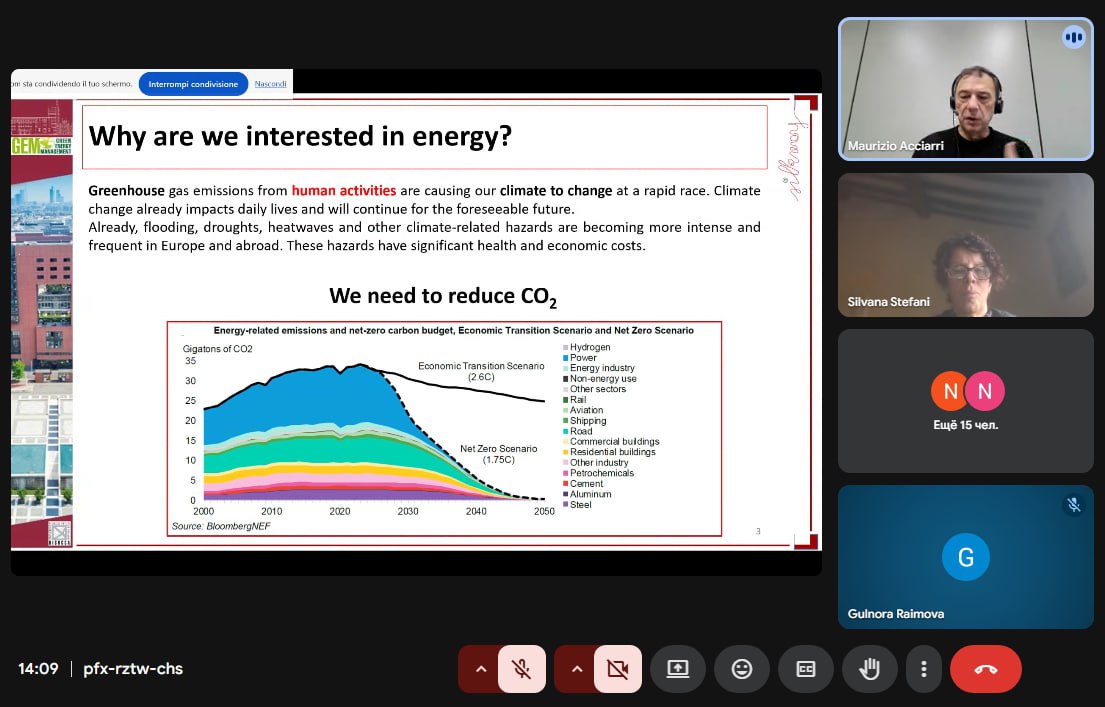
On 3 December 2025, an online meeting was held between faculty members of the Departments of System Analysis and Mathematical Modeling, International Economics, and International Finance and Investments of the University of World Economy and Diplomacy and researchers from Italy. The initiative for this event came from the Department of System Analysis and Mathematical Modeling. The meeting, conducted via Google Meet, brought together around 20 participants and focused on exploring opportunities for launching joint research projects in the fields of energy, climate risk management, financial technologies, and mathematical modeling.
The first presentation was delivered by Prof. Maurizio Acciarri (University of Milano–Bicocca, Italy), who discussed modern research in solar energy, energy system efficiency, and the integration of renewable energy sources into power grids. Particular attention was devoted to technological solutions aimed at enhancing grid stability—such as smart inverters, grid-forming inverters, energy storage systems, and flexible load management. Prof. Acciarri also presented approaches to forecasting energy production that combine physical models, statistical methods, and advanced AI/Deep Learning technologies. Among the most promising research directions, he highlighted physics-informed neural networks, digital twins, federated learning, and the expanded use of AI for energy system management.
A separate part of the presentation focused on UREWA — Uzbekistan Remote Energy and Water Access, a project aimed at introducing integrated solar solutions to improve access to clean energy and water in rural regions of Uzbekistan. Discussions addressed issues of energy poverty, water security, and unequal access to essential resources.
The second presentation was delivered by Prof. Silvana Stefani (Catholic University of Sacred Heart, Italy), who examined modern financial and insurance instruments used for managing climate-related risks. She provided an in-depth analysis of the economic consequences of global climate change and compared traditional insurance contracts with weather derivatives and temperature indices such as HDD and CDD. Particular emphasis was placed on parametric insurance products, which offer automated, fast, and transparent payout mechanisms based on objectively measurable data. Prof. Stefani also presented examples of hybrid financial instruments that combine features of derivatives and insurance contracts, as well as valuation methods based on statistical modeling and time series analysis.
At the conclusion of the meeting, participants discussed potential areas for future cooperation, including the development of joint research projects, preparation of co-authored publications, organization of scientific seminars, and promotion of multidisciplinary initiatives between universities of Uzbekistan and Italy. Among the most promising research directions were forecasting energy consumption, analyzing climate risks, creating hybrid financial instruments for managing weather fluctuations, and applying artificial intelligence and mathematical modeling to sustainable development challenges. These areas provide a strong foundation for long-term and productive international scientific collaboration.
| Date: | 03.12.2025 |
| Views: | 1448 |
| Share: |