High quality of education

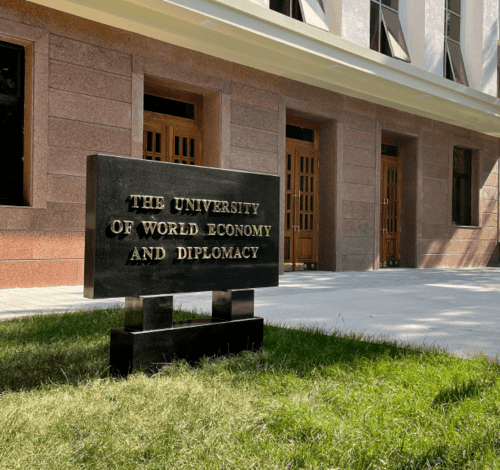
The University of World Economy and Diplomacy

Learn more

Career starts here

The most prestigious university of Uzbekistan

Learn more

The Place That Brings Students Together

UWED Students' Council

Learn more

Undergraduate

Autumn semester for undergraduate

More

Master's degree

A one-year master's program

More

"Smart University"

From 2023, the activities of the University of World Economy and Diplomacy will be transformed

More
Bachelorʼs Degree

Bachelorʼs Degree

The University of World Economy and Diplomacy offers undergraduate programs in a variety of fields, including: International Relations,  Political Science, International Economics and Management Jurisprudence. UWED's bachelor's degree programs are designed to provide students with the knowledge and skills they need to succeed in a globalized world. The programs are taught by a team of experienced faculty members, many of whom have held high-level positions in government and business. UWED also offers a variety of extracurricular activities and opportunities for students to gain hands-on experience in their field of study. One of the most popular bachelor's degree programs at UWED is the International Economics and Management program. This program provides students with a strong foundation in economics, international trade, and finance. Students also learn about the political and legal environment of international business. Another popular bachelor's degree program at UWED is the International Relations program. This program provides students with a comprehensive understanding of international relations, foreign policy, and diplomacy. Students also learn about the history and culture of different countries.  UWED also offers bachelor's degree programs in Political Science and Jurisprudence. These programs are designed to prepare students for careers in government, law, business, and other fields. Here are some of the benefits of earning a bachelor's degree from UWED: A strong academic foundation in your chosen field Exposure to a diverse range of cultures and perspectives The opportunity to network with other students and professionals from around the world The chance to gain hands-on experience through internships and other extracurricular activities A competitive edge in the job market If you are looking for a challenging and rewarding educational experience, UWED is the perfect place for you. With its world-class faculty, state-of-the-art facilities, and diverse student body, UWED is committed to providing its students with the knowledge and skills they need to succeed in today's globalized world. Interview for blind applicants for undergraduate studies for the 2025-2026 academic year.
More

Study at UWED

The University of World Economy and Diplomacy was established on September 23, 1992. It is functioning under the Ministry of Foreign Affairs of the Republic of Uzbekistan.

It is a higher educational institution that provides training, retraining and advanced training for specialists and academic staff as well as conducts high-level fundamental and applied research in the following areas:

  • International Economics and Management;
  • International Relations and Political Science;
  • International Public and Private Law;
  • Jurisprudence.
More
Study at UWED

News & Events

All news
UWED Discusses Practical Problems of Establishing Judicial Truth

UWED Discusses Practical Problems of Establishing Judicial Truth

On December 15 of the current year, a master class entitled “Practical Issues Arising in the Process of Establishing the Truth by Courts of First Instance” was organized at the University of World Economy and Diplomacy. The event was initiated by D. Soliyev, Senior Lecturer of the Department of International Law and Public Law, and was held for third-year students of the Faculty of International Law. The event featured Khurshid Abdisamad ugli Sodiqov, an investigating judge of the Uchtepa District Criminal Court, as a guest expert. In his presentation, the speaker addressed the relevance of establishing the truth in the activities of courts of first instance within the context of ongoing judicial and legal reforms. During the meeting, the expert provided students with explanations regarding the practical problems encountered in the process of establishing the truth by courts of first instance, the causes of these problems, and the effectiveness of existing legal mechanisms. In particular, the discussion focused on difficulties related to the collection and evaluation of evidence, the limits of the court’s active role, the procedural activity of the parties, as well as approaches to judicial initiative. Special attention was also given to the content of the principle of establishing the truth in procedural legislation, the need to maintain a balance between judicial initiative and impartiality, and the importance of the obligation to provide reasoned justification when assessing evidence. In direct dialogue with the expert, students raised questions concerning the role of the court in establishing the truth, the necessity of thorough examination of evidence, the adoption of appropriate procedural decisions, and the importance of increasing public and business entities’ trust in the judiciary. The master class emphasized that strengthening mechanisms for establishing the truth in courts of first instance is a crucial condition for ensuring judicial justice. It was also noted that such forms of cooperation between courts and higher education institutions have a positive impact on the quality of education and play a significant role in developing students’ practical and professional skills.

141
An educational lesson was held on the topic “Our ancestors-Jadids”

An educational lesson was held on the topic “Our ancestors-Jadids”

On December 15 of this year, within the framework of the “Hour of the Future” project, a lecture entitled “The Emergence of the Jadid Movement” was held for students of the Faculty of International Relations at the University of World Economy and Diplomacy. This event became one of the important educational meetings aimed at enriching young people’s historical knowledge and fostering national thinking and a modern worldview. The lecture was delivered by Doctors of Political Science, Professors Sultanova E’tibor Siddikovna and Djurayev Qodir Asadovich. During the lecture, the social, political, and cultural factors that led to the emergence of the Jadid movement in Turkestan in the late 19th and early 20th centuries were thoroughly analyzed. In particular, it was emphasized that the backwardness of the education system at that time, the intensification of colonial policies, and the necessity of increasing public literacy played a significant role in shaping Jadid ideas. Detailed information was also provided about the activities of prominent Jadid figures such as Mahmudkhoja Behbudi, Abdulla Avloni, and Munavvarqori Abdurashidkhanov, as well as their efforts to establish new-method schools and awaken society through the press and literature. During the event, special attention was paid to the socio-political, spiritual, and educational significance of the Jadid movement and its role in the process of national awakening. It was noted that the Jadids’ views on science, education, culture, and national self-awareness remain relevant for today’s youth. This lecture played an important role in broadening students’ historical thinking, deepening their understanding of national identity and enlightenment ideas, and strengthening their independent thinking and sense of loyalty to the Motherland.

68
UWED Professor Participated in a Specialized Training Program Organized within the ITEC Program

UWED Professor Participated in a Specialized Training Program Organized within the ITEC Program

From 3 to 12 December 2025, Surayyo Usmanova, Acting Professor of the Department of International Law and Public Law Disciplines, participated in a specialized training program entitled “Contemporary Issues of the World Trade Organization, Sustainability, and International Trade”, held in New Delhi under the ITEC (Indian Technical and Economic Cooperation) program implemented by the Government of India. The training program was organized by the World Trade Organization Studies Centre and covered a range of topical issues, including the WTO system and its linkage with sustainable development, agriculture and food security, TRIPS and intellectual property rights, trade facilitation, investment promotion, subsidies, climate change, e-commerce, digital trade, the WTO dispute settlement mechanism, and WTO reforms. During the program, on 10 December, Surayyo Usmanova delivered a presentation at the participants’ presentation sessions on Uzbekistan’s accession process to the World Trade Organization. The presentation highlighted the country’s ongoing negotiations, domestic reforms, alignment with WTO rules, and the expected impact of WTO membership on national trade policy. As part of the program, Surayyo Usmanova attended lectures and practical sessions conducted by leading scholars, former WTO ambassadors, and international experts, gaining valuable knowledge and skills in trade policy relevant to developing countries. The knowledge and experience gained through this program will contribute to the further development of Surayyo Usmanova’s research and teaching activities, as well as to the training of highly qualified specialists in the fields of international economic law and trade law.

105

Our partners

https://mgimo.ru/
https://www.undp.org/
https://www.berkeley.edu/
https://www.unibe.ch/index_eng.html
https://www.ox.ac.uk/
https://pennstatelaw.psu.edu/
https://www.wto.org/
https://www.columbia.edu/
https://www.gla.ac.uk/
https://www.wti.org/